Listening
You will be assessed on your ability to understand:
- the main ideas and detailed factual information,
- the opinions and attitudes of speakers,
- the purpose of a spoken text, and
- the sequence and development of ideas.
Question types
There are six main questions types used in the IELTS listening test:
- Multiple choice
- Matching
- Labelling (plan, map, and diagram)
- Completion (form, note, table, flow-chart, and summary)
- Sentence completion
- Short-answer
Tips on listening for specific information
-
Tip 1: Pay attention to question words
-
Tip 2: Listen for any changes to specific information
-
Tip 3: Practise listening to numbers and spelling.
Practise listening to numbers and spelling in English. For example, people’s names, numbers for passports, telephone numbers, addresses, dates and so o
Listening for numbers
There are different ways of expressing numbers involving time, distances, and currencies.
10:15 = ten fifteen, a quarter past ten, fifteen past ten, forty-five to 11
10.50 = 10 50, 10 dollars and 50, 10 dollars and 50 cents, 10 pounds fifty pence
1.5 million = one and half million, one point five million
30 August = the thirtieth of August, August the thirtieth
21/6/04 = the twenty-first of June two thousand and four
9949-7767 = 'nine nine four nine seven six six seven' or 'double nine four nine seven double six seven'
Similar sounding numbers
| 13 thirteen | 30 thirty |
|---|---|
| 14 fourteen | 40 forty |
| 15 fifteen | 50 fifty |
| 16 sixteen | 60 sixty |
| 17 seventeen | 70 seventy |
| 18 eighteen | 80 eighty |
| 19 nineteen | 90 ninety |
L.3.3.3_general-numbers_audio-only.mp3
One difference between these sets of numbers is that the sound “-teen” is longer than the sound “-ty“. The other difference is that the syllable “-teen” is stressed when pronounced, while “-ty” is not.
| Time | hour + minutes | minutes + hour |
|---|---|---|
| 6:25 | six twenty-five | twenty-five past six |
| 6:35 | six thirty-five | twenty-five to seven |
| 7:15 | seven fifteen | a quarter past seven |
| 10:45 | ten forty-five | a quarter to eleven |
| 2:30 | two thirty | half past two |
Notice the difference between the two times in the minutes + hour format. Before the thirty minute mark (i.e. 6:30), we use the word ‘past’. For 6:25 we say ‘twenty-five past six because 25 minutes have passed since 6 o’clock. However, after the thirty minute mark, we need to use the word ‘to’. This is because the time is approaching the next hour, so in this case, we are approaching 7 o’clock. With the time 6:35, there are 25 minutes until we reach 7 o’clock; therefore, we say ‘twenty-five to seven’. For times involving 15 and 45 minutes, we can use ‘a quarter’, and 30 minutes ‘half’.
If your answer includes a date and it is said in its ordinal form, you can write it without ‘th’. This means that, for example, 17 August or 17th August would both be marked correct.
If you decide to write the full word for the month, remember that it must be written in Capitals letters (i.e. August and not august)
Dollar currencies that are most commonly used in the Listening test are: U.S. dollars (US$), Canadian dollars (C$), Australian dollars (A$), New Zealand dollars (NZ$), Singapore dollars (S$), and Hong Kong dollars (HK$). However, in your answers, you do not need to write the specific currency; you only need to write the dollar sign ($).
| Suffix | Abbreviation |
|---|---|
| Street | St |
| Road | Rd |
| Drive | Dr |
| Lane | Ln |
| Way | No abbreviation |
| Avenue | Ave |
| Boulevard | Blvd |
| Highway | Hwy |
| Parade | Prd |
| Circus | No abbreviation |
Part 2
You can use to recognize speakers' opinions is listening for stressed words. By ‘stressed’ we mean words that are emphasized when we speak in order to show important words. This is a common conversational feature that speakers use to highlight facts and express opinions.
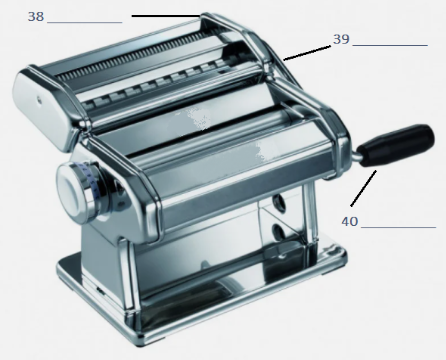
Now, by looking at the diagram and knowing that it is showing a process, you can possibly predict how the information is organized. 38, 39 and 40